How AOD works.

The lifecycle, six stages.

AOD organizes work into six stages — Discover, Define, Plan, Build, Deliver, Document. Each stage produces a named artifact that the next stage consumes, and each stage boundary is a governance gate where one or more Triad roles sign off. The agent runs the same slash commands every session against the same locked artifacts, so the output is reproducible across runs and across humans. This is the lifecycle, not a process diagram.

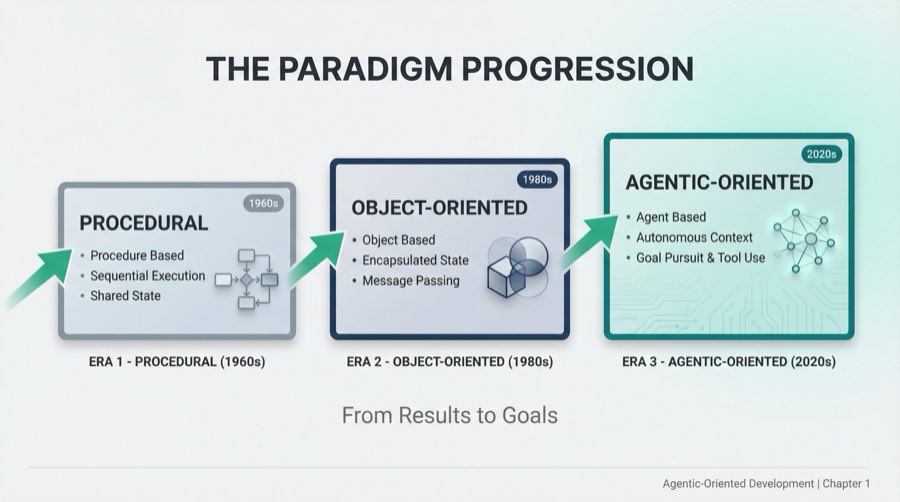
The Paradigm Progression

Discover

/aod.discover

Capture a feature idea, score it with ICE, and gather evidence before it earns a slot in the backlog. The gate at the exit is PM validation: the idea has a clear user problem, a target user, and a measurable outcome. Run with /aod.discover. The artifact that leaves the stage is a scored idea, not a half-written PRD.
Define

/aod.define

Write the PRD with full Triad review — PM, Architect, and Team-Lead each sign off. The gate at the exit is triple-signed product requirements: what gets built, why, the technical baseline, and the realistic timeline. Run with /aod.define. The artifact that leaves the stage is a PRD the spec phase consumes verbatim.

Plan

/aod.plan

Translate the PRD into three artifacts in sequence — spec, project plan, and tasks — with sign-off gates between each. The gate at the exit is triple-signed tasks: PM, Architect, and Team-Lead approve before any code is written. Run with /aod.plan. The artifact that leaves the stage is an implementation contract the build phase executes against.

Build

/aod.build

Execute the tasks in parallel waves with Architect checkpoints at every critical phase — design quality, security scan, code simplification. The gate is continuous: the Architect approves at each checkpoint or sends the work back. Run with /aod.build. The artifact that leaves the stage is implemented, tested, and gate-checked code ready for the Deliver stage.

Deliver

/aod.deliver

Verify the Definition of Done — pushed to production, tested, user-validated — run the retrospective, and close the feature. The gate at the exit is the full Triad DoD check. Run with /aod.deliver. The artifact that leaves the stage is a closed feature with a retrospective on the books and a draft PR marked ready for review.

Document

/aod.document

Run a human-approved quality review — code simplification, docstrings, CHANGELOG updates, API docs. Each step asks for explicit human approval before applying. Run with /aod.document. The artifact that leaves the stage is a maintainable codebase with the institutional knowledge captured for the next human or agent to pick up.

What it looks like.

A real /aod.define invocation. The user asks for a dark-mode feature, three Triad agents respond with sign-offs, and a PRD lands on disk. No animation, no typing effect, just the static output you would see in your own shell.

~/projects/agentic-oriented-development, fish
$ /aod.define dark-mode
product-manager: Drafting PRD with 5 user stories,
acceptance criteria, and ICE-scored success metrics.
Saved draft to specs/NNN-dark-mode/spec.md.
architect: APPROVED. Static export compatible.
Zero new dependencies. CSS tokens within budget.
team-lead: APPROVED. 3 waves, ~5h aggregate.
Wave 0a parallel, Wave 1 sequential, Wave 2 review.
✓ PRD locked at docs/product/02_PRD/NNN-dark-mode-2026-MM-DD.md

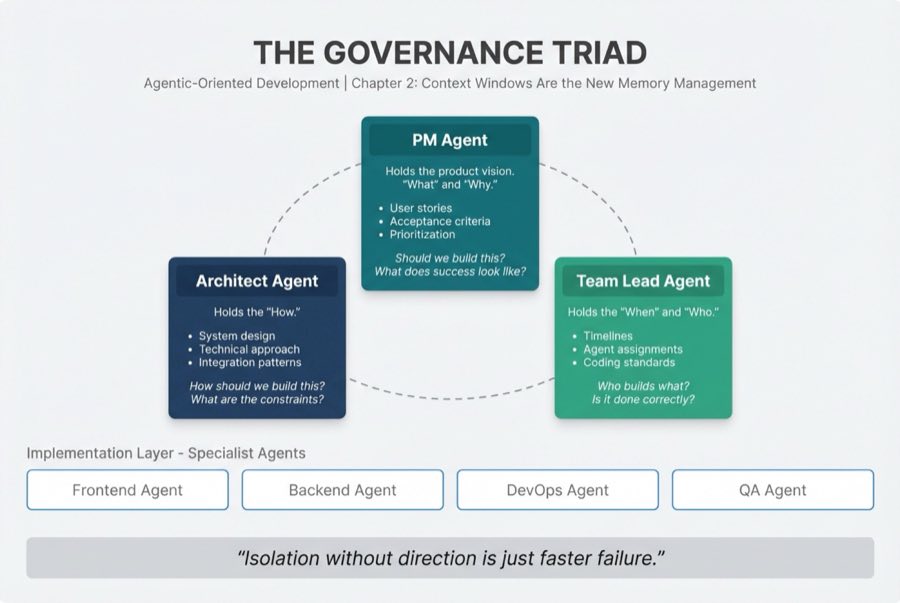
Three roles, three sign-offs.

RoleDefinesAuthority
Product ManagerWhat & WhyScope & requirements
ArchitectHowTechnical decisions
Team-LeadWhen & WhoTimeline & resources
The Governance Triad
spec.md
PM
plan.md
PM + Architect
tasks.md
PM + Architect + Team-Lead

Four rungs from prompt to agent.

Vibe Coder

Prompts replace specs.Treats the AI as a smarter autocomplete and ships whatever the model felt like producing on that run.
At this rung there is no contract. The prompt is the spec; the output is whatever the model produced this session. Two runs of the same prompt produce two different programs. There is no governance, no sign-off, no reproducibility — just one engineer pair-programming with one agent in one window. It is the cheapest place to start and the hardest place to scale.

Prompt Engineer

Better prompts, same agent.Crafts targeted prompts to elicit specific model behavior, with a library of prompt patterns that get reused across sessions.
The prompt is the artifact. Prompt Engineers keep a library — system prompts, few-shot patterns, role frames — and tune them empirically across runs. The agent itself stays generic; the engineer's leverage is the wording. This rung scales further than Vibe Coding because the prompts become reusable, but the contract still lives in plain English and still drifts under context pressure.

Context Engineer

Context is the new memory.Treats the agent's context window as a managed resource, with explicit rules for what enters, what stays, and what gets evicted.
The prompt is still input; the context window is the workspace. Context Engineers design hierarchies — base context, specialized context, isolation boundaries — and they treat context drift as a first-class engineering problem. The agent's outputs become more reproducible because the inputs are explicit and bounded. The rung that follows extends this further: agents themselves become specialized and governed.

Agentic Engineer

Specifications govern the agent.Designs specialized agents with named roles, governed handoffs, and explicit sign-off gates at every stage boundary.
The agent is no longer a single generic model with prompts taped on. Agentic Engineers compose Triads of specialized agents — Product Manager, Architect, Team-Lead — each with named authority and sign-off gates. The contract is the spec the agent works against, not a suggestion it can route around. Two runs of the same feature produce the same kind of output. This is the rung AOD is built for.

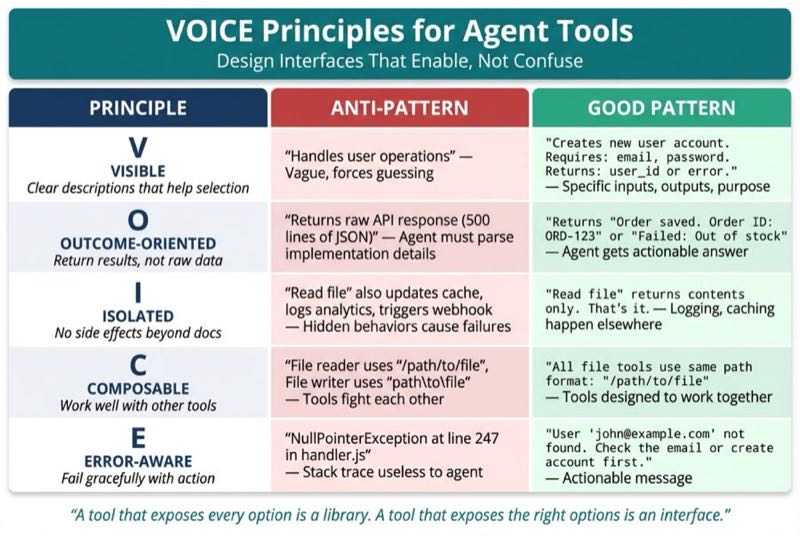
VOICE: five principles for agent tools.

VOICE Principles for Agent Tools

Visible

A tool's purpose, inputs, and effects are obvious from its name and signature alone. The agent should never have to guess what the tool does or what argument shape it accepts.

A search tool named find_files_by_extension(ext: string) -> Path[] is Visible; a search tool named search(query: any) -> any is not — the agent has to infer the contract from trial and error.

Outcome-oriented

A tool surfaces what changed in the world, not what was attempted. Return a result the agent can act on — never a vague success flag and a stack trace to parse.

A file-write tool returns { path, bytes_written, sha256 } so the next step can verify and reference the artifact; returning only { ok: true } forces the agent to re-discover the world from scratch.

Isolated

A tool does one thing and has no hidden coupling to other tools or to global state. The blast radius of any single call is bounded and inspectable.

A commit_changes tool that stages, commits, and pushes in one call is not Isolated — three separate tools (stage, commit, push) let the agent stop after any step and let a reviewer see the intermediate state.

Composable

A tool's output is shaped to be another tool's input. Pipelines emerge from the tool set without an orchestration layer dictating them.

A list_files tool that returns Path[] composes directly with a read_file(path: Path) tool — the agent chains them with no glue code. If the first returned strings and the second expected typed Path, the agent would have to write a coercion step every time.

Error-aware

A tool fails loudly with structured information the agent can recover from. No silent failures, no buried exceptions, no truncated stack traces with the actual cause stripped.

A delete_file tool returns { ok: false, reason: "file_locked", locked_by: "process_id_47291" } so the agent can retry, escalate, or pick a different file — not just { ok: false } with a wall of text in stderr.

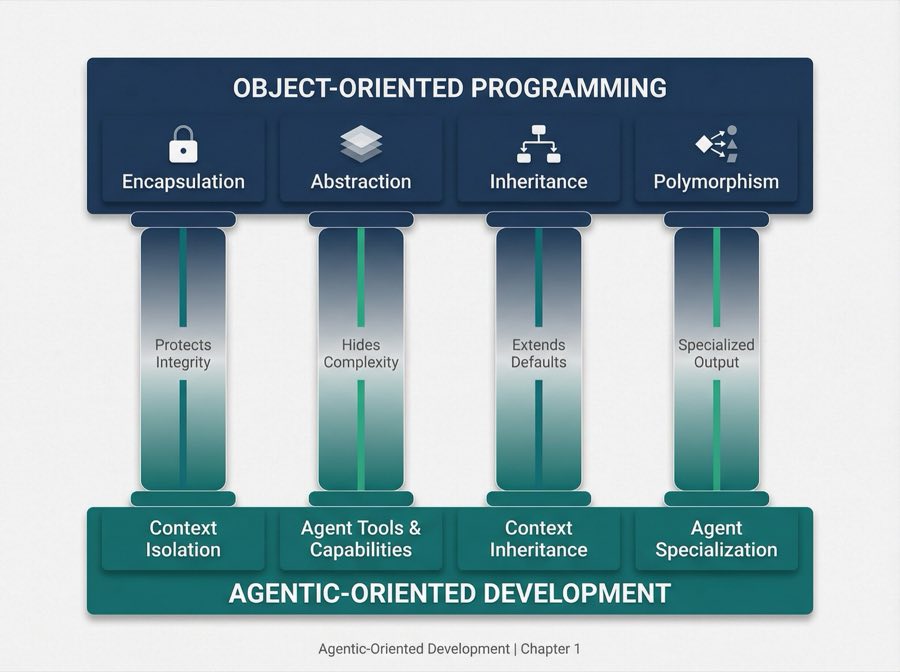
Four pillars: OOP, mapped to agents.

The Four Pillars - OOP to AOD
OOP conceptAOD counterpartExplanation
EncapsulationContext IsolationEncapsulation hides an object's internal state behind a public interface. Context Isolation does the same for an agent — the context window is the private state, and only the explicit handoff (spec, plan, tasks) is the public interface the next agent consumes.
AbstractionTool InterfacesAbstraction hides implementation detail behind a method signature. Tool Interfaces do the same for an agent — the tool's name and signature are the contract the agent reasons against, and the implementation is free to change without changing what the agent has to know.
InheritanceConfig HierarchyInheritance lets a class extend another class while overriding specific methods. Config Hierarchy does the same for an agent — a base context defines the defaults, and specialized contexts (CLAUDE.md, skills, hooks, tool configs) extend or override them with complete-override semantics.
PolymorphismAgent SpecializationPolymorphism lets a single interface dispatch to many implementations. Agent Specialization does the same for an agent — natural language is the shared interface, and the runtime picks a specialized agent (PM, Architect, Team-Lead, frontend-developer, tester) based on the work in front of it.

Where to go next.

Ready to install? See Getting Started.